
When someone asks me, “What’s the best app to help with mental health?” my honest answer is usually: there isn’t one. And that’s not because mental health apps don’t work; many actually do, but because “best” assumes a single perfect solution exists for everyone’s unique brain, struggles, and daily life.
That’s just not how mental health works.
The truth is more nuanced and, frankly, more interesting. The real question isn’t which single app reigns supreme, but rather how you can build a small, thoughtful digital toolkit that genuinely supports your wellbeing without exposing your most vulnerable thoughts to the highest bidder.
What makes this question so tricky is that mental health apps exist in a weird middle ground. They’re not quite therapy, not quite self-help books, and, in most cases, definitely not regulated medical devices.
Some are backed by solid clinical trials showing real symptom reduction. Others are basically mood-tracking diary apps dressed up with pastel colors and inspirational quotes.
And a disturbing number quietly harvest deeply intimate data, your panic attacks at 2 AM, your suicidal thoughts, your relationship struggles, with privacy policies so vague they might as well be written in invisible ink.
So instead of hunting for the mythical “best” app, I’m going to walk you through how to think about mental health apps more strategically: what actually works according to research, what data matters beyond “how do I feel today,” and which privacy red flags should send you running.
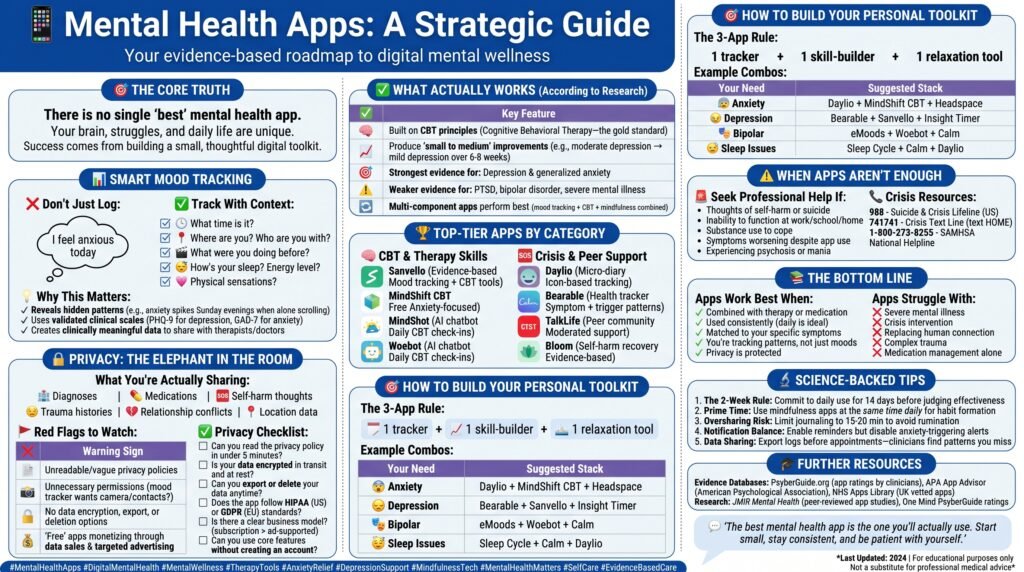
What Makes an Evidence-Based Mental Health App?
Here’s something that surprised me when I first dug into the research: most mental health apps in your app store have never been tested in any meaningful clinical trial. (Linardon et al., 2024, pp. 139-149) They just… exist.
Someone had an idea, hired developers, and launched it with bold claims to reduce anxiety or improve sleep.
No peer review, no control groups, no longitudinal data.
The apps that have been properly studied tend to share certain DNA. They’re usually built around cognitive behavioral therapy (CBT) principles, the gold-standard talk therapy approach that focuses on changing cognitive patterns and behaviors. (Denecke et al., 2022)
These apps guide you through exercises like identifying negative thoughts, challenging them with evidence, and testing new behaviors.
The approach is structured, active, and meta-analyses consistently show it produces small to medium improvements in depression and anxiety symptoms when delivered through apps. (Seegan et al., 2023)
What does “small to medium” actually mean? In research terms, we’re talking about effect sizes that are statistically significant but not dramatic.
Think of it like this: if you’re starting with moderate depression, an evidence-based app might move you toward mild depression over several weeks of regular use.
That’s genuinely helpful, especially if therapy isn’t accessible to you right now. But it’s probably not going to feel like a light switch flipping.
The strongest evidence exists for depression and generalized anxiety. When researchers pool results from hundreds of trials, apps targeting these conditions regularly outperform control groups. (Valentine et al., 2024)
The picture gets murkier for PTSD, bipolar disorder, severe mental illness, and suicidal ideation.
Some preliminary studies show promise, but the evidence base is thinner, and the stakes are obviously much higher. (Seegan et al., 2023, pp. 171-183)
Interestingly, apps that mix many components, say, mood tracking plus CBT exercises plus mindfulness practices, tend to show better outcomes than single-function tools. (Bakker et al., 2018, pp. 75-83) It makes intuitive sense: you’re not just meditating or just logging your mood; you’re building awareness and skills simultaneously.
How Mood Tracking Apps Actually Improve Mental Health
Most people approach mental health apps like digital journals: “I feel anxious today. I feel better today. I feel awful today.” This creates a mountain of subjective impressions without much useful pattern recognition. Your memory is terrible at reconstructing emotional timelines, and confirmation bias means you’ll remember the bad days more vividly than the gradual improvements. (Wardell & Palombo, 2024)
Really useful apps solve this by adding structure and context. Instead of just “How do you feel?” they ask, “What time is it?”
Where are you?
Who are you with? What were you doing right before this feeling hit?
Did you sleep well last night?
How’s your energy level? Are you noticing any physical sensations?
This changes vague feelings into data points with coordinates. After a few weeks, patterns emerge that you’d never spot otherwise.
Maybe your anxiety consistently spikes on Sunday evenings when you’re alone scrolling social media. (Editorial, 2026)
Maybe your mood improves significantly on days when you talk to friends, even briefly. Maybe your sleep quality is a better predictor of next-day depression than anything else.
Some sophisticated apps use validated clinical scales, the same questionnaires therapists use, to track symptoms over time. The PHQ-9 for depression, the GAD-7 for anxiety. (The Effect of Depression and Anxiety Symptom Severity on Clinical Outcomes and App Use in Digital Mental Health Treatments: Meta-Regression of Three Trials, 2020)
These give you standardized measurements that mean something beyond your personal baseline.
If your PHQ-9 score drops from 18 to 12 over six weeks, that’s a clinically meaningful improvement that you can talk about with a provider. (Clinically meaningful changes on depressive symptom measures and patient-reported outcomes in patients with treatment‐resistant depression, 2020, pp. 1130-1138)
The really cutting-edge (and sometimes creepy) territory is passive sensing. Some apps can pull in data from your phone’s sensors: step count, GPS movement patterns, screen time, typing speed, even voice analysis.
The idea is to detect mental health changes before you’re consciously aware of them.
If your movement radius suddenly shrinks, your phone usage goes nocturnal, and your typing becomes slower and more error-prone, algorithms would mark this as a potential onset of depression. (Angel et al., 2022)
This is powerful but raises obvious privacy concerns, which brings me to the elephant in the room.
Mental Health App Privacy: What You Need to Know
Multiple independent security reviews have found that many popular mental health apps have weaknesses that might expose user data, share information with third parties, or keep records even after account deletion. (Fadilpašić, 2026) We’re not talking about abstract risks; researchers have documented apps transmitting unencrypted mental health details, sharing crisis information with analytics companies, and using vague language to obscure data practices. (Iwaya et al., 2022)
Think about what you’re putting into these apps. Diagnoses.
Medication names.
Thoughts of self-harm. Relationship conflicts.
Trauma histories.
This is categorically different from sharing your step count or favorite restaurants. If this data leaks, is sold, or gets subpoenaed, the consequences can be devastating: employment discrimination, insurance complications, custody battles, social stigma. (Gooding & Kariotis, 2020)
The business models matter here. Free apps usually monetize through data collection and advertising, which creates inherent conflicts between end-user privacy and revenue. (The Quality and Characteristics of Digital Mental Health Apps: Mixed Methods Study, 2026)
Paid apps have their own issues; subscription frameworks can lock essential features behind paywalls, but at least the incentive structure is slightly more consistent with user interests. (Chang et al., 2023)
When I assess an app’s privacy stance, I look for several concrete things. First, can I actually read and understand the privacy statement in under ten minutes?
If it’s written in impenetrable legalese or vague about what “we may share data with partners” actually means, that’s a red flag.
Second, what permissions does the app ask for? If a mood tracker wants access to my camera, microphone, contacts, and location when none of those are necessary for core functionality, I’m out.
Third, is data encrypted both in transit and at rest? Can I export my data?
Can I fully delete my account and all associated records?
Some mental health apps have actually gotten this right. Independent app libraries maintained by professional organizations now rate tools on both clinical quality and privacy practices, giving users a more goal-based basis for choice than app store rankings driven by marketing budgets. (MindApps.org, n.d.)
Building Your Personal Mental Health App Toolkit
Instead of searching for a single perfect app, I recommend thinking in terms of a small toolkit of specialized components. Here’s how I’d approach it:
The Skills Builder should be one app focused on teaching concrete psychological techniques. CBT-based apps are your strongest bet here, with solid research to back them.
Look for tools that walk you through thought records, behavioral experiments, exposure hierarchies, or solution-focused frameworks.
The best ones feel as though you have a therapy workbook on your phone, structured, sometimes challenging, focused on changing patterns as opposed to just feeling better temporarily.
The Awareness Tool is your mood and symptom tracker. It should make regular check-ins quick but meaningful, ideally with both scales and space for context notes.
The goal is to build a longitudinal picture of your mental state that reveals patterns you can’t see day to day.
Bonus points if it uses validated clinical measures or lets you customize what you track based on your particular concerns.
The Calm-Down Resource is something for acute stress, panic, or insomnia. This might be a mindfulness app with guided meditations and breathing exercises, or a sleep app with progressive muscle relaxation.
The key is accessibility; when you’re spiraling at midnight, you need something you can open and use immediately without scrolling through menus.
Observe that this is three apps, not fifteen. More isn’t better.
Each extra app adds friction, notification noise, and decision fatigue.
The best toolkit is the one you’ll actually use consistently.
Mental Health App Toolkit Finder
Build your personalized digital toolkit based on evidence-based recommendations
Based on your responses, here are evidence-based recommendations for building your digital mental health toolkit. Remember: apps work best when used consistently over several weeks and as supplements to professional care when needed.
- Read privacy policies before entering any personal mental health information
- Look for apps that encrypt data both in transit and at rest
- Minimize app permissions – only grant access to features actually needed for core functionality
- Favor paid apps or those from established healthcare organizations over free apps that monetize through data collection
- Verify that you can export your data and fully delete your account
- Use strong, unique passwords and enable two-factor authentication when available
Matching Apps to Your Actual Situation
The “best” app changes dramatically based on where you’re starting from and what you’re trying to accomplish. If you’re dealing with mild to moderate depression and have never tried any structured self-help, a comprehensive CBT app might be genuinely transformative.
If you’re already in therapy and doing well, adding a simple mood tracker to bring data into your sessions could accelerate progress.
For specific conditions, look for specialized tools. Veterans dealing with PTSD might benefit from apps developed by organizations like the VA, which are free, have no advertising, and were designed with clinical input for that exact population.
People struggling with insomnia have access to apps based on CBT for insomnia, a particular protocol with strong evidence that’s quite different from generic sleep meditations.
Age and context matter too. Apps designed for teens commonly incorporate peer stories, school-specific scenarios, and communication features that wouldn’t make sense for older adults. (Götzl et al., 2022)
Workplace mental health apps might focus heavily on stress management and burnout prevention instead of on clinical symptoms. (Rischer et al., 2025)
That integration question is huge. Apps work better as adjuncts to professional care than as replacements, especially for moderate-to-severe conditions.
If you’re seeing a therapist, look for apps that let you export your data, mood charts, thought records, and sleep logs so you can bring concrete information into sessions rather than relying on memory.
This turns your app from a solo self-help tool into a therapeutic accelerator.
Common Mistakes That Waste Time and Money
The biggest mistake I see is downloading five apps in a burst of motivation, using them inconsistently for a week, and then abandoning them all when the novelty wears off. Mental health apps are like exercise equipment; they only work if you actually use them, and sporadic use rarely produces significant change. (Valentine et al., 2025)
Start with one app. Use it daily for at least two weeks before evaluating its effectiveness. If it’s not clicking, switch to a different one, but give each tool a fair trial.
Research on app effectiveness assumes frequent engagement; using a CBT app twice in three weeks won’t move the needle. (Wu et al., 2021)
Another trap is confusing pleasant distraction with therapeutic progress. Apps with beautiful interfaces and soothing sounds might feel good in the moment without actually teaching you skills or changing patterns. (Seegan et al., 2023, pp. 171-183)
There’s nothing wrong with comfort, but if your goal is symptom reduction or skill-building, you need apps with some structure and active exercises, not simply passive consumption of inspirational content.
Privacy mistakes are particularly costly. People often breeze through permission asks and privacy policies without reading them, then later learn their mental health data is being shared more broadly than they’d ever imagined. (Editorial, 2026) Take 10 minutes up front to understand what you’re agreeing to.
If the app’s privacy practices are unclear or troubling, that’s valuable information; find a different tool.
Finally, there’s the trap of using apps to avoid professional care when it’s actually needed. Apps showing small to moderate effects in research trials are most useful for mild to moderate symptoms, as supplements to other support, or when access to traditional care is limited. (Fuhrmann et al., 2023) If you’re experiencing severe depression, active suicidal thoughts, psychosis, or substantial functional impairment, apps are not an adequate substitute for professional assessment and treatment.
How Apps Fit Into Your Larger Mental Health Strategy

Mental health apps work best as one component in a broader support system, not as isolated solutions. Think of them as sitting in a middle tier between basic self-care (sleep, exercise, social connection) and professional intervention (therapy, medication, intensive treatment).
Apps shine when they help you build consistency with evidence-based practices that would otherwise fall by the wayside. (Kraiss et al., 2026) It’s hard to remember to do a breathing exercise when panic hits unless you’ve practiced it repeatedly.
It’s easy to forget which cognitive distortions you’re prone to unless you’re logging them regularly.
Apps create structure, reminders, and reinforcement that support habit formation.
They’re particularly valuable for extending and strengthening the work done in therapy. (Kraiss et al., 2026) If your therapist teaches you cognitive restructuring but you only practice it once a week in session, progress will be slow.
If you practice it daily with an app between sessions, skills develop much faster.
Some therapists now explicitly prescribe specific apps to clients as homework, creating a deliberate integration between digital tools and talk therapy. (González-Robles et al., 2024)
For people waiting for therapy (waiting lists can stretch weeks or months (Sun et al., 2023, pp. 1-7)), apps can provide meaningful support in the interim. They’re not a substitute, but they’re vastly better than struggling alone.
Similarly, for people stepping down from intensive treatment, apps can help maintain gains and provide early warning if symptoms creep back up. (Gumley & al., 2022, p. 410)
The relationship between apps and medication is interesting too. Apps won’t replace psychiatric medication when it’s needed, but mood tracking can help you and your prescriber make better decisions.
Detailed logs showing when symptoms improved, whether side effects appeared, and how functioning changed give much clearer information than trying to remember “how the last two months went” in a 15-minute med check appointment. (Malhi et al., 2023, pp. 102-106)
Practical Next Steps
If you’re ready to try mental health apps, here’s a concrete roadmap. First, clarify your specific goal.
“I want to feel better” is too vague.
“I want to reduce my panic attacks,” “I want to understand what triggers my depressive episodes,” or “I want to build a daily mindfulness habit” give you clear criteria for choosing and evaluating apps.
Second, use an independent app library or rating system rather than relying on app store rankings. Organizations like the American Psychiatric Association maintain vetted collections that assess both clinical quality and privacy.
This dramatically narrows your search to apps that meet basic standards.
Third, commit to a real trial period. Download one app, set up daily reminders, and use it consistently for three weeks.
Track not just how you feel but whether you’re actually learning skills, noticing patterns, or changing behaviors.
If it’s not working after a genuine trial, switch to a different tool rather than giving up on apps entirely.
Fourth, protect your privacy proactively. Read privacy policies, minimize permissions, use strong unique passwords, activate two-factor authentication if available, and favor apps that offer data export and deletion.
If an app’s privacy practices make you uncomfortable, trust that instinct and choose something else.
Finally, think about apps as one part of your mental health strategy, not the whole thing. Keep investing in sleep, movement, relationships, and professional support where needed. Apps are tools, not magic bullets, and they work best when embedded in a life that supports wellbeing through many channels.
Frequently Asked Questions
Can meditation apps help with anxiety?
Yes, meditation apps can help with anxiety, particularly when used regularly. Research shows that mindfulness-based interventions delivered through apps can reduce anxiety symptoms in people with mild to moderate anxiety. (Macrynikola et al., 2024)
The key is persistent practice, usually at least 10-15 minutes daily for several weeks.
Apps that teach specific techniques like body scans, breathing exercises, and guided imagery tend to be more effective than those that just play relaxing sounds.
What is the PHQ-9 score?
The PHQ-9 (Patient Health Questionnaire-9) is a nine-item questionnaire that screens for depression and measures symptom severity. Scores range from 0 to 27, with 0-4 indicating minimal depression, 5-9 mild, 10-14 moderate, 15-19 moderately severe, and 20-27 severe depression. (Kroenke et al., 2001, pp. 606-613)
Many mental health apps incorporate the PHQ-9 to track your depression symptoms over time using the same standardized measure that clinicians use.
Do mental health apps really work?
Mental health apps can work for mild to moderate symptoms, particularly depression and generalized anxiety. Research shows small-to-medium effect sizes, meaning they produce measurable improvements that are statistically significant. (Fuhrmann et al., 2023)
However, they work best when used consistently over several weeks and are typically used as supplements to other forms of support rather than as standalone treatments.
Apps are generally less effective for severe mental illness, complex trauma, or conditions requiring medication. (Sawyer et al., 2023, pp. 6965-7005)
Are free mental health apps safe?
Free mental health apps vary widely in terms of safety, particularly regarding data privacy. Many free apps monetize through data collection and advertising, which may compromise your privacy.
Before using a free app, check whether it encrypts your data, read the privacy policy to understand what information is collected and shared, and verify whether the app has been independently reviewed for security.
Apps from established healthcare organizations or government agencies (such as VA apps for veterans) tend to have stronger privacy protections. (What VA is doing to Protect Your Privacy, 2026)
Can I use mental health apps instead of therapy?
Mental health apps work best as complements to therapy rather than replacements, especially for moderate-to-severe conditions. Apps can be helpful if you’re on a waiting list for therapy, stepping down from intensive treatment, or have mild symptoms and scarce access to care. (Linardon et al., 2024, pp. 139-149)
However, if you’re experiencing severe depression, active suicidal thoughts, trauma symptoms, or significant functional impairment, you need specialist assessment and treatment that apps alone cannot provide.
How do CBT apps work?
CBT (Cognitive Behavioral Therapy) apps teach you to identify and change unhelpful cognitive patterns and actions. They typically guide you through exercises like thought records (where you log negative thoughts and challenge them with evidence), behavioral activation (scheduling rewarding activities), exposure hierarchies (gradually facing feared situations), and problem-solving techniques. (Erhardt et al., 2022)
The apps provide structure and reminders to practice these skills daily, which helps you develop new mental habits over time.
What mood tracking app is best?
The best mood tracking app depends on what you want to track and how much detail you need. Look for apps that let you log context (what you were doing, where you were, who you were with) alongside your mood ratings; use validated clinical scales like the PHQ-9 or GAD-7; allow data export so you can review patterns or share with a therapist; and have transparent privacy policies. Apps that balance quick daily assessments with enough detail to expose patterns tend to be most useful. (Kraiss et al., 2026)
Do mindfulness apps help with sleep?
Mindfulness apps can help with sleep, particularly for people whose insomnia is related to racing thoughts, stress, or anxiety. (The effectiveness of smartphone app-based interventions for insomnia and sleep disturbances: A meta-analysis of randomized controlled trials, 2024, pp. 237-244) Apps that offer body scan meditations, progressive muscle relaxation, or breathing exercises can help you relax before bed. However, if you have chronic insomnia, you might benefit more from apps specifically designed around CBT for insomnia, which addresses the behavioral and cognitive patterns that perpetuate sleep problems. (Linardon et al., 2024, pp. 237-244)
Key Takeaways:
There is no single “best” mental health app because effectiveness depends entirely on your specific symptoms, goals, context, and preferences. The strongest evidence supports CBT-based apps for depression and generalized anxiety, with small to medium effect sizes that are meaningful but not dramatic. (Linardon et al., 2024, pp. 139-149)
Building a small toolkit, typically one skills-training app, one mood tracker, and one calm-down resource, works better than hunting for one perfect solution. Choose apps with transparent privacy policies, minimal data collection, and the ability to export or delete your information.
Mental health apps are most effective when used as adjuncts to professional care rather than as replacements, especially for moderate-to-severe conditions. Regular, consistent use over several weeks is essential; sporadic engagement rarely produces meaningful change.
Structured data tracking that captures context, patterns, and validated symptom measures provides far more value than vague daily mood ratings. The goal is to transform subjective feelings into visible patterns that lead to better decisions.
Privacy risks in mental health apps are real and significant, with many popular tools showing serious vulnerabilities or data-sharing practices. Taking ten minutes to assess an app’s privacy stance before entering intimate information is time well spent.
References
Denecke, K., Schmid, N. & Nüssli, S. (2022). Implementation of Cognitive Behavioral Therapy in e–Mental Health Apps: Literature Review. Journal of Medical Internet Research 24(3). https://doi.org/10.2196/27791
Wardell, V. & Palombo, D. J. (2024). Stability and malleability of emotional autobiographical memories. Nature Reviews Psychology 3. https://doi.org/10.1038/s44159-024-00312-1
Editorial, S. P. (2026). Sunday Scaries: The Psychology of Pre-Week Dread. Simply Psychology. https://www.simplypsychology.com/articles/sunday-scaries-psychology
Forman-Hoffman, V. L., Hsyeh, E., Kanagaraj, M., Gille, A., Ceneviva, M. & Grant, C. (2026). Patient-Provider Matching, Engagement, and Outcomes of a Digital Mental Health Treatment Platform: Real-World Retrospective Cohort Study. JMIR Formative Research 10. https://doi.org/10.2196/81121
(2020). Clinically meaningful changes on depressive symptom measures and patient-reported outcomes in patients with treatment‐resistant depression. American Journal of Psychiatry 177(12), pp. 1130-1138. https://doi.org/10.1176/appi.ajp.2020.20030356
Angel, V. D., Lewis, S., White, K., Oetzmann, C., Leightley, D., Oprea, E., Lavelle, G., Matcham, F., Pace, A., Mohr, D. C., Dobson, R. & Hotopf, M. (2022). Digital health tools for the passive monitoring of depression: a systematic review of methods. npj Digital Medicine 5. https://doi.org/10.1038/s41746-021-00548-8
Gooding, P. & Kariotis, T. (February 29, 2020). Mental Health Apps Are Not Keeping Your Data Safe. Scientific American. https://www.scientificamerican.com/article/mental-health-apps-are-not-keeping-your-data-safe/
(2026). The Quality and Characteristics of Digital Mental Health Apps: Mixed Methods Study. JMIR Human Factors 13. https://doi.org/10.2196/67944
Chang, C., Palermo, E., Deswert, S., Brown, A. & Nuske, H. J. (2023). Money can’t buy happiness: A randomized controlled trial of a digital mental health app with versus without financial incentives. Digital Health 9. https://doi.org/10.1177/20552076231170693
Götzl, C., Hiller, S., Rauschenberg, C. & Schick, A. (2022). Artificial intelligence-informed mobile mental health apps for young people: a mixed-methods approach on users’ and stakeholders’ perspectives. Child and Adolescent Psychiatry and Mental Health 16. https://doi.org/10.1186/s13034-022-00522-6
Rischer, K. M., Betz, L. T., Riepenhausen, A., Meyer, B., Jacob, G. A., Frieling, H. & Jauch-Chara, K. (2025). A randomized controlled trial of an interactive digital therapeutic for stress and burnout management. npj Mental Health Research 4. https://doi.org/10.1038/s44184-025-00184-0
Valentine, L., Hinton, J. D., Bajaj, K., Boyd, L., O’Sullivan, S., Sorenson, R. P., Bell, I. H., Vega, M. S., Liu, P., Peters, W., Mangelsdorf, S. N., Wren, T. W., Moller, C. & Cross, S. (2025). A meta-analysis of persuasive design, engagement, and efficacy in 92 RCTs of mental health apps. npj Digital Medicine. https://doi.org/10.1038/s41746-025-01567-5
Seegan, P. L., Miller, M. J., Heliste, J. L., Fathi, L. & McGuire, J. F. (2023). Efficacy of stand-alone digital mental health applications for anxiety and depression: A meta-analysis of randomized controlled trials. Journal of Psychiatric Research 164, pp. 171-183. https://doi.org/10.1016/j.jpsychires.2023.06.019
Editorial, S. P. (2026). Mental Health App Privacy: What Happens to Your Most Sensitive Data. Simply Psychology. https://www.simplypsychology.com/articles/mental-health-app-privacy
Kraiss, J., Fiß, F., Chakhssi, F., Aktas, F. B., Koelen, J. A. & Simões, J. P. (2026). Identifying what works in mental health apps through meta-regression analyses of 169 trials. npj Digital Medicine. https://doi.org/10.1038/s41746-026-02466-z
Gumley, A. I. & al., e. (2022). Digital smartphone intervention to recognise and manage early warning signs in schizophrenia to prevent relapse: the EMPOWER feasibility cluster RCT. Health Technology Assessment 26(1), p. 410. https://doi.org/10.3310/hta26110
Malhi, G. S., Hamilton, A., Morris, G., Mannie, Z., Das, P. & Outhred, T. (2023). The promise of digital mood tracking technologies: are we heading on the right track?. Evidence Based Mental Health 20(4), pp. 102-106. https://doi.org/10.1136/ebmental-2023-300400