
If you’re trying to track your mental health with technology, you’re staring at a pretty overwhelming range of gadgets, apps, and marketing promises. Some of these wearable devices for mental health really do furnish valuable data that can help you understand your stress fluctuations, sleep quality, and corporeal responses in ways that weren’t accessible outside clinical settings just a few years ago.
The challenge is that “mental health wearable” now covers everything from your everyday smartwatch to specialized EEG headbands, smart rings that track your recovery, stress-relief bracelets that vibrate, chest patches that continuously monitor your heart rhythm, and even smart pills with ingestible sensors. Each category works differently, measures different things, and has varying levels of scientific backing.
Making the right choice could give you genuinely useful awareness of your anxiety triggers or sleep disruptions. Making the wrong choice might leave you with a drawer full of abandoned gadgets and a subscription fee you neglected to cancel.
These devices are collecting some of your most sensitive data: your stress levels, sleep patterns, heart rate variability, and sometimes even your medication adherence. According to research, many consumer wearables aren’t covered by HIPAA protections, which means manufacturers can potentially share or sell that data under their terms of service. (The perils of connecting wearables with medical records, 2026)
Choosing the right mental health wearable means understanding both features and accuracy, plus knowing what happens to your data. If you’re considering a wearable to support your mental health, here’s what you really need to know about how these devices work, what they can and can’t do, and which options might actually be worth your attention.
Understanding Mental Health Wearables
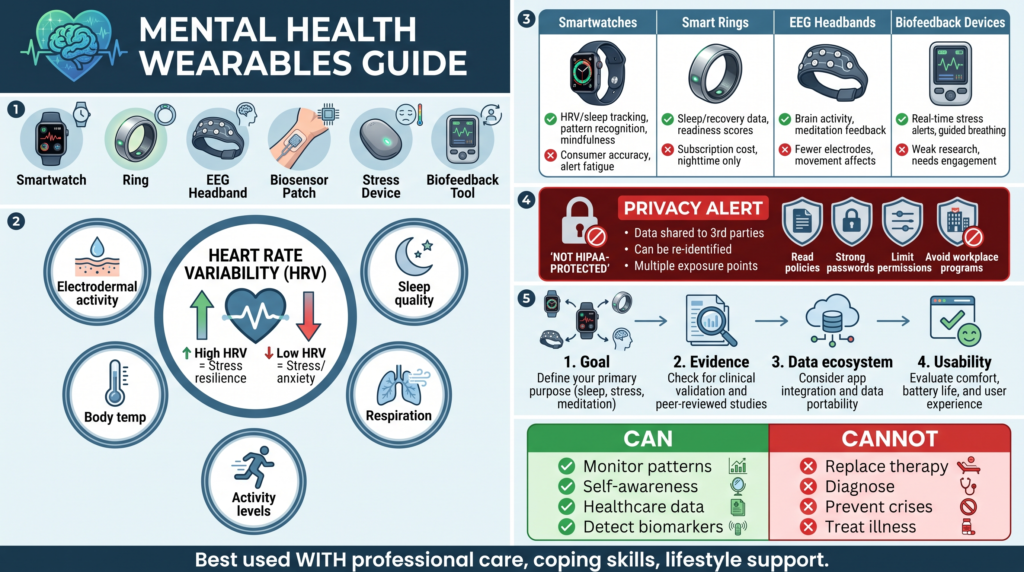
Mental health wearables are fundamentally different from traditional medical monitoring because they’re trying to capture something fundamentally complex and subjective, your emotional state, through indirect biological signals. Your smartwatch can’t directly measure anxiety or depression the way a blood pressure cuff measures your BP.
Instead, these devices track biomarkers that research has linked to mental health states. (Hirten et al., 2024)
The most important biomarker you’ll encounter is heart rate variability, or HRV. This measures the variation in time intervals between your heartbeats, and HRV is far more informative about stress and mental self-regulation than your average heart rate. (Holzman & Bridgett, 2017, pp. 233-255)
When you’re stressed or anxious, your HRV typically decreases because your sympathetic nervous system (fight-or-flight) is more active.
When you’re calm and recovered, your HRV increases because your parasympathetic nervous system (rest-and-digest) has more influence.
Studies consistently show that HRV, combined with other signals such as electrodermal activity (essentially, how much your skin sweats in response to stress) and respiration patterns, provides much better stress detection than heart rate alone. But here’s where it gets tricky: many popular fitness trackers still primarily rely on average heart rate for their “stress scores,” which substantially reduces accuracy. (Costantini et al., 2023)
Beyond physiological signals, some systems also track behavioral patterns, such as how much you move, how long you sleep, how often you interact with others via your phone, and even your screen time and location. These behavioral digital biomarkers can reveal changes in routine that often precede mood episodes, like gradually withdrawing from social contact or developing irregular sleep schedules.
Smartwatches and Fitness Trackers for Mental Health

The most available entry point into mental health wearables is the smartwatch or fitness tracker you might already own. Devices like the Apple Watch, Fitbit Sense, and various Garmin models now include mental health-relevant features that go well beyond step counting.
Apple Watch tracks HRV during sleep and can tell you about irregular heart rhythms, high or low heart rates, and periods of elevated stress. The Mindfulness app prompts breathing exercises, and third-party apps can use the watch’s sensors for more detailed HRV tracking and biofeedback.
Fitbit Sense includes an EDA sensor that you activate by placing your palm over the watch face for a brief stress assessment, along with continuous heart rate, HRV, and sleep tracking.
What I find really valuable about these mainstream devices, in my opinion, is the longitudinal view they provide. When you wear the same device consistently for weeks or months, you start to see your personal patterns, maybe your HRV always drops on Sunday nights when you’re dreading the work week, or your sleep quality tanks during certain times of the month, or your stress levels correlate with specific activities or social situations.
The limitation is that these consumer devices are optimized for broad appeal rather than medical accuracy. Research comparing devices like the Apple Watch and Fitbit with medical-grade equipment shows that they measure resting heart rate reasonably well, but accuracy declines significantly during movement, and their ability to distinguish between different mental states remains limited. (Accuracy of Heart Rate Measurement Under Transient States: A Validation Study of Wearables for Real-Life Monitoring, 2023) You might see your “stress score” rise, but understanding what that number really means and whether it’s actionable needs greater context than the app typically provides.
There’s also the problem of alert fatigue. Getting constant notifications about your stress level or sleep quality can become its own source of anxiety.
I can easily imagine there being people who became obsessed with improving their readiness scores to the point where the tracking itself became stressful, checking the app first thing in the morning and allowing a low score to decide their entire mood for the day.
Smart Rings and Biosensor Patches

Smart rings like the Oura Ring take a different approach by focusing intensively on sleep, recovery, and fitness. Oura measures heart rate, HRV, body temperature, and movement throughout the night to generate detailed sleep stage information and a readiness score that reflects how well your body has recovered.
What makes Oura particularly interesting for mental health is the temperature tracking. Your baseline body temperature fluctuates with stress, illness, hormonal cycles, and other factors that affect mental wellbeing.
Catching temperature trends early can alert you to physiological strain before you consciously notice you’re struggling.
The readiness score combines multiple signals to indicate whether your body is prepared for a challenging day or needs recovery, which can be really valuable for managing energy and preventing burnout. (Marzorati et al., 2025)
The downside is that Oura requires a subscription for full-feature access, and the device is designed primarily for nighttime wear, so you’re not getting daytime stress monitoring or activity tracking with the identical level of detail as a smartwatch. But for people who prioritize sleep optimization as a mental health strategy, Oura provides some of the most detailed consumer-grade sleep data available.
Biosensor patches represent a more clinical-grade approach. Devices like VitalPatch and Zio are adhesive patches that continuously record ECG data and upload it to cloud platforms.
These patches are used in cardiac monitoring, but they’re more frequently employed in psychiatric and sleep research because they provide highly detailed, continuous HRV data without requiring users to remember to wear them or charge batteries. (Wearable Sensing Systems for Monitoring Mental Health, 2022)
The challenge with patches is that they’re typically used in clinical or research contexts instead of direct-to-consumer, and they raise even bigger questions about where the data goes and who has access to it. But they show what’s possible when you prioritize measurement reliability more than everyday wearability.
EEG Headbands and Neurofeedback

To go beyond heart-based metrics and actually measure brain activity, EEG headbands like Muse and Emotiv bring neurofeedback technology out of the lab and into your home. These devices use electrodes to detect electrical activity in your brain and translate it into a real-time evaluation of your mental state.
Muse markets itself primarily for meditation, providing audio feedback that responds to your brainwave patterns. When your mind wanders, the soundscape becomes more turbulent; when you’re focused and calm, it becomes more peaceful. The idea is that this biofeedback helps you learn to recognize and cultivate calmer mental states.
Muse S adds sleep tracking and plays responsive soundscapes designed to ease you into sleep based on your brain activity and movement.
Emotiv takes a more research-oriented approach, offering EEG headsets with many channels that can be used for cognitive training, attention monitoring, and even brain-computer interface applications. These devices are used by researchers studying stress, mental workload, and emotional self-regulation.
The appeal of EEG headbands is that they’re measuring something directly related to your mental activity, not just inferring it from your heart rate. The limitation is that consumer EEG devices use fewer electrodes and less intricate signal processing than clinical EEG systems, and factors such as scalp contact quality, hair, and movement can affect accuracy. Research shows that while these devices can detect broad changes in mental state (e.g., focused versus relaxed), they’re not yet reliable for more subtle or specific mental health assessments. (Hickey et al., 2021)
There are also more experimental multimodal headband systems being developed that mix EEG with HRV monitoring and even transcranial electrical stimulation, essentially mixing measurement and intervention in a single device. These systems show promise for more accurate mental health monitoring through integrating multiple signal types, but they’re still mostly in the research phase.
Stress Regulation and Biofeedback Wearables
A growing category of wearables focuses specifically on stress regulation through various forms of stimulation or biofeedback. Apollo Neuro is a wristband or ankle band that delivers gentle vibration patterns designed to influence your nervous system toward calmness or focus.
The company claims these vibrations, called “Apollo Vibes,” can shift your autonomic balance, reduce stress, improve sleep, or increase energy, depending on the pattern you choose.
TouchPoints uses alternating bilateral tactile stimulation (vibrations that alternate between two devices worn on each wrist or clipped to your body) based on research into EMDR therapy. The idea is that this alternating stimulation can help calm the nervous system during stressful moments. (Effectiveness of wearable device-based interventions on improving depression, anxiety, stress, and quality of life in adults: A systematic review and meta-analysis, 2026)
Here’s where the evidence gets really thin. While HRV and EDA sensors can reliably detect physiological stress responses, randomized controlled trials of these stress-relief wearables show modest and inconsistent effects on subjective anxiety and little evidence of durable changes in stress biomarkers. Some studies suggest a placebo effect, the act of engaging with the device and focusing on your stress may be helpful, but not necessarily because of the specific intervention the device provides. (Wilson et al., 2025, pp. 345-358)
That doesn’t mean these devices are worthless. If wearing a vibrating wristband reminds you to pause to breathe when you’re stressed, and that helps, then it’s serving a useful function as a behavioral cue. (Azevedo et al., 2017)
But you should be skeptical of marketing claims that suggest the device itself is profoundly altering your nervous system through proprietary vibration patterns.
HRV biofeedback wearables like Lief take a more evidence-based approach. Lief is a small device that attaches to your chest and continuously monitors your HRV, then prompts you via smartphone alerts when it detects stress signatures.
The app guides you through paced breathing exercises designed to increase HRV.
The device is essentially teaching you to recognize physiological stress and providing tools to modulate it, which fits well with established biofeedback therapy principles.
HRV biofeedback has reasonably good research support for alleviating anxiety and strengthening emotional management when combined with structured practice. (Wilson et al., 2025) The wearable makes this accessible outside of therapy sessions, allowing you to practice throughout your day.
But the benefit still depends heavily on your willingness to actually stop and do the breathing exercises when prompted, which is where many people struggle.
Privacy and Data Security Concerns
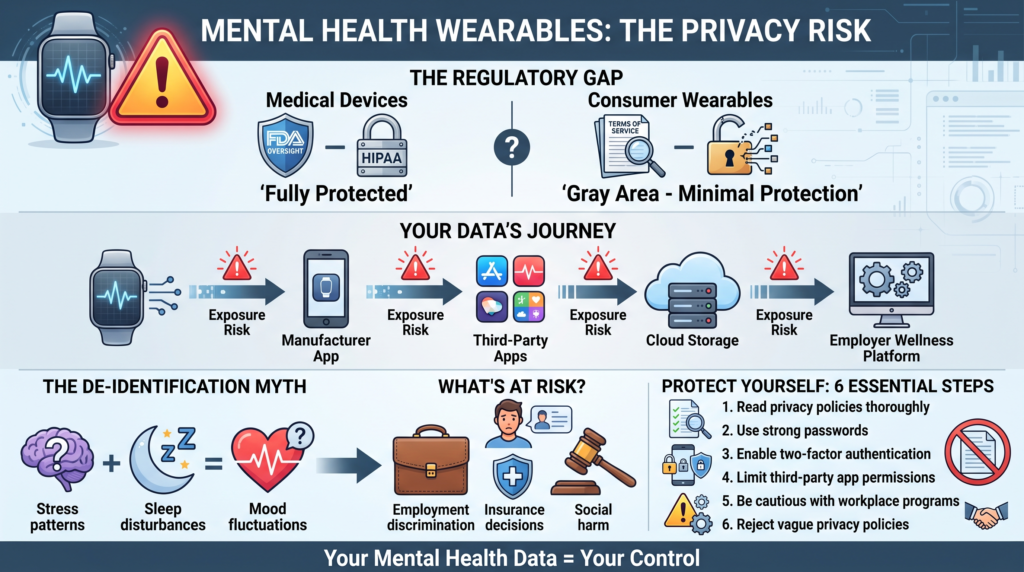
One of the biggest problems with mental health wearables is that most consumer devices exist in a regulatory ambiguous area. Unlike medical devices subject to FDA oversight and HIPAA privacy protections, consumer wellness wearables are often governed only by the company’s terms of service and privacy terms.
Research shows that manufacturers frequently claim broad rights to collect, use, and share health data, sometimes including the right to de-identify and sell it to third parties. And “de-identified” data isn’t always as anonymous as it sounds; studies have demonstrated that combining many data points can allow people to be re-identified from supposedly anonymous datasets. (Chikwetu et al., 2023)
The app ecosystems around wearables create additional vulnerabilities. When your mental health data flows between your wearable, the manufacturer’s app, third-party health apps, cloud storage services, and potentially your employer’s wellness platform, each transfer creates opportunities for data exposure. (Doherty et al., 2025)
Many of these apps have vague disclosures about what data they access and where it goes. (Parker et al., 2019, pp. 198-204)
For mental health data specifically, the stakes are high. Stress indicators, sleep disturbances, and mood fluctuations are sensitive information that could potentially be used for employment discrimination, insurance decisions, or other forms of social harm if not properly protected. (Singer & Eddington, 2026) (Capulli et al., 2025) Before choosing a mental health wearable, you really need to read the privacy agreement and understand where your data is stored, who can access it, and what control you have over its deletion or sharing. Using strong passwords, enabling two-factor authentication, limiting permissions for third-party apps, and proceeding carefully with workplace wellness programs that involve data sharing are all important steps. To be honest, if a device’s data protection policy is vague or concerning, that’s a valid reason to choose a different product.
How to Choose the Right Mental Health Wearable
Start by clarifying what you’re actually trying to track or improve. If you want broad wellness monitoring and you’re mainly interested in sleep and recovery, a smartwatch or smart ring makes sense.
If you’re working on meditation and attention training, an EEG headband might be more suitable.
If you’re specifically tracking stress responses and want real-time biofeedback, look at HRV-focused devices with guided breathing.
Consider the level of evidence behind the device. Has it been studied in clinical populations?
Are the claims backed by published research, or are they mainly marketing?
Does the company transparently explain what its sensors measure and how its algorithms work?
Evaluate the data ecosystem. Where does your data go?
Who owns it?
Can you export it or delete it? Are there third-party apps or integrations that would expose your data to additional parties?
Does the company have a track record of protecting end-user privacy?
Think about long-term usability. Will you actually wear this device every day?
Does it need charging often?
Are there ongoing subscription costs? What happens if the company goes out of business or stops supporting the device?
And be realistic about what the device can and can’t do. Wearables are excellent monitoring tools that can increase self-awareness and provide useful data to inform your coping strategies or discussions with healthcare providers.
They don’t replace professional mental health care, and their ability to forecast or prevent crises is still limited by current technology and research.
🧠 Find Your Perfect Mental Health Wearable
Answer a few questions to discover which device best matches your mental health goals and lifestyle
Your Personalized Recommendations
Based on your responses, here are the mental health wearables best suited for you
People Also Asked
What is the best wearable for anxiety?
The best wearable for anxiety depends on what you’re trying to track. If you want continuous stress monitoring and sleep tracking, the Apple Watch or Fitbit Sense offer good all-around features.
If you want real-time HRV biofeedback with guided breathing exercises, Lief is specifically designed for anxiety management.
For people who prioritize sleep optimization as part of anxiety regulation, the Oura Ring provides detailed recovery metrics.
Does Apple Watch track mental health?
Apple Watch tracks several metrics relevant to mental health, including heart rate variability during sleep, resting heart rate, sleep phases, and activity levels. The Mindfulness app provides guided breathing sessions.
While these features can provide useful data about stress and recovery patterns, the Apple Watch doesn’t directly diagnose or treat mental health conditions.
Can Fitbit detect stress?
Fitbit devices, particularly the Fitbit Sense, include an EDA (electrodermal activity) sensor that measures skin conductance changes associated with stress responses. The device also tracks heart rate variability and provides a daily stress management score.
However, these measurements reflect physiological arousal as opposed to directly measuring psychological stress.
What is heart rate variability and why does it matter?
Heart rate variability (HRV) measures the variation in time intervals between consecutive heartbeats. Higher HRV generally indicates better stress resilience along with autonomic nervous system balance, whereas lower HRV is associated with stress, fatigue, and poor recovery.
HRV tracking helps identify stress indicators and recovery needs before you consciously feel overwhelmed.
Are mental health wearables covered by HIPAA?
Most consumer mental health wearables are not covered by HIPAA because they’re classified as wellness devices rather than medical devices. This means your data may not have the same privacy protections as health information shared with doctors. (Protecting the Privacy and Security of Your Health Information When Using Your Personal Cell Phone or Tablet, 2022)
Always read the data privacy statement to understand how your data is collected, stored, and potentially shared.
Can wearables help with depression?
Wearables can help monitor patterns associated with depression, such as sleep disturbances, decreased activity levels, and changes in heart rate variability. This data can support treatment by noticing early warning signs or tracking response to interventions.
However, wearables are monitoring tools, not treatments, and should be used alongside professional care.
What is the Oura Ring used for?
The Oura Ring specializes in sleep tracking, recovery monitoring, and readiness scoring. It measures heart rate, HRV, body temperature, and movement throughout the night.
For mental health purposes, it’s particularly useful for people who want to improve sleep quality and track how well their bodies recover from stress.
Do EEG headbands really work?
Consumer EEG headbands like Muse can detect broad changes in brain activity and provide biofeedback for meditation practice. However, they use fewer electrodes and less sophisticated processing than clinical EEG equipment.
Research shows they can help with meditation training and general relaxation, but they’re not reliable for detailed mental health assessment.
Key Takeaways
Mental health wearables span from everyday smartwatches to dedicated EEG headbands, biofeedback devices, and biosensor patches. Each type fulfills different purposes and has varying levels of scientific support.
HRV is the most research-supported biomarker for stress-related and emotional self-regulation. Wearables that accurately measure HRV, especially when combined with sleep, activity, and EDA data, provide genuinely useful awareness of mental health patterns. The evidence for wearables as monitoring and awareness tools is stronger than the evidence for wearables as direct treatments. Most studies show these devices can detect stress and track relevant biomarkers, but randomized trials of stress-relief interventions delivered via wearables have produced modest and inconsistent outcomes. (Klimek et al., 2023)
Privacy represents a vital consideration that many people overlook. Consumer mental health wearables often aren’t covered by HIPAA, and your stress, sleep, and mood data may be collected, stored, and potentially shared in ways that are inadequately protected.
View mental health wearables as one component of a holistic method that includes professional care, established coping skills, lifestyle management, and social support. Used thoughtfully, these devices are able to enhance self-awareness and empower you to make data-informed decisions about your mental health.
References
Matias, I., Haas, M., Daza, E. J., Kliegel, M. & Wac, K. (2026). Digital biomarkers for brain health: passive and continuous assessment from wearable sensors. npj Digital Medicine 9. https://doi.org/10.1038/s41746-026-02340-y
Marzorati, D., Rossi, A. D., Svihrova, R., Grossenbacher, M. & Faraci, F. D. (2025). Burnout Risk Prediction through Wearable Devices: An Initial Assessment. Annu Int Conf IEEE Eng Med Biol Soc. 2025 Jul:2025:1-5.. https://doi.org/10.1109/EMBC58623.2025.11252971
(2022). Wearable Sensing Systems for Monitoring Mental Health. Sensors 22(3). https://doi.org/10.3390/s22030994
(2026). Effectiveness of wearable device-based interventions on improving depression, anxiety, stress, and quality of life in adults: A systematic review and meta-analysis. Journal of Affective Disorders 407. https://doi.org/10.1016/j.jad.2026.121804
Azevedo, R. T., Bennett, N., Bilicki, A., Hooper, J., Markopoulou, F. & Tsakiris, M. (2017). The calming effect of a new wearable device during the anticipation of public speech. Scientific Reports 7. https://doi.org/10.1038/s41598-017-02274-2
Doherty, C., Baldwin, M., Lambe, R., Altini, M. & Caulfield, B. (2025). Privacy in consumer wearable technologies: a living systematic analysis of data policies across leading manufacturers. npj Digital Medicine 8(1). https://doi.org/10.1038/s41746-025-01757-1
Parker, L., Halter, V., Karliychuk, T. & Grundy, Q. (2019). How private is your mental health app data? An empirical study of mental health app privacy policies and practices. International Journal of Law and Psychiatry 64, pp. 198-204. https://doi.org/10.1016/j.ijlp.2019.04.002
Singer, J. A. & Eddington, P. G. (March 18, 2026). The Feds Are Investing in Wearable Health Trackers. That Could Put Your Private Data at Risk.. Cato Institute. https://www.cato.org/commentary/feds-are-investing-wearable-health-trackers-could-put-private-data-risk