When you first think about mental health apps, you might picture someone with clinical depression downloading a therapy tool, or maybe a stressed-out college student trying a meditation app before finals. And sure, those are absolutely part of the picture.
But the reality of who actually uses mental health apps, and whom developers are trying to reach, has way more layers and, honestly, some pretty surprising angles.
The market has exploded in the past few years, and with it, the audience has fragmented into segments that go far beyond the “person in crisis” stereotype. Some people are chasing peak performance and focus, not symptom relief.
Others are using apps to support a loved one, not themselves.
And then there’s the whole corporate wellness angle, where entire workforces get apps pushed to them whether they asked or not.
If you’ve ever wondered who these tools are really for, or whether you fit the profile, you’re in the right place. Let’s pull back the curtain on the surprisingly diverse world of mental health app users.
The Core Audience Extends Way Beyond Clinical Cases
Most people assume mental health apps are built for people with diagnosed conditions: depression, anxiety, PTSD, bipolar disorder. That’s the logical assumption, right?
But when you actually look at the data, the picture shifts dramatically.
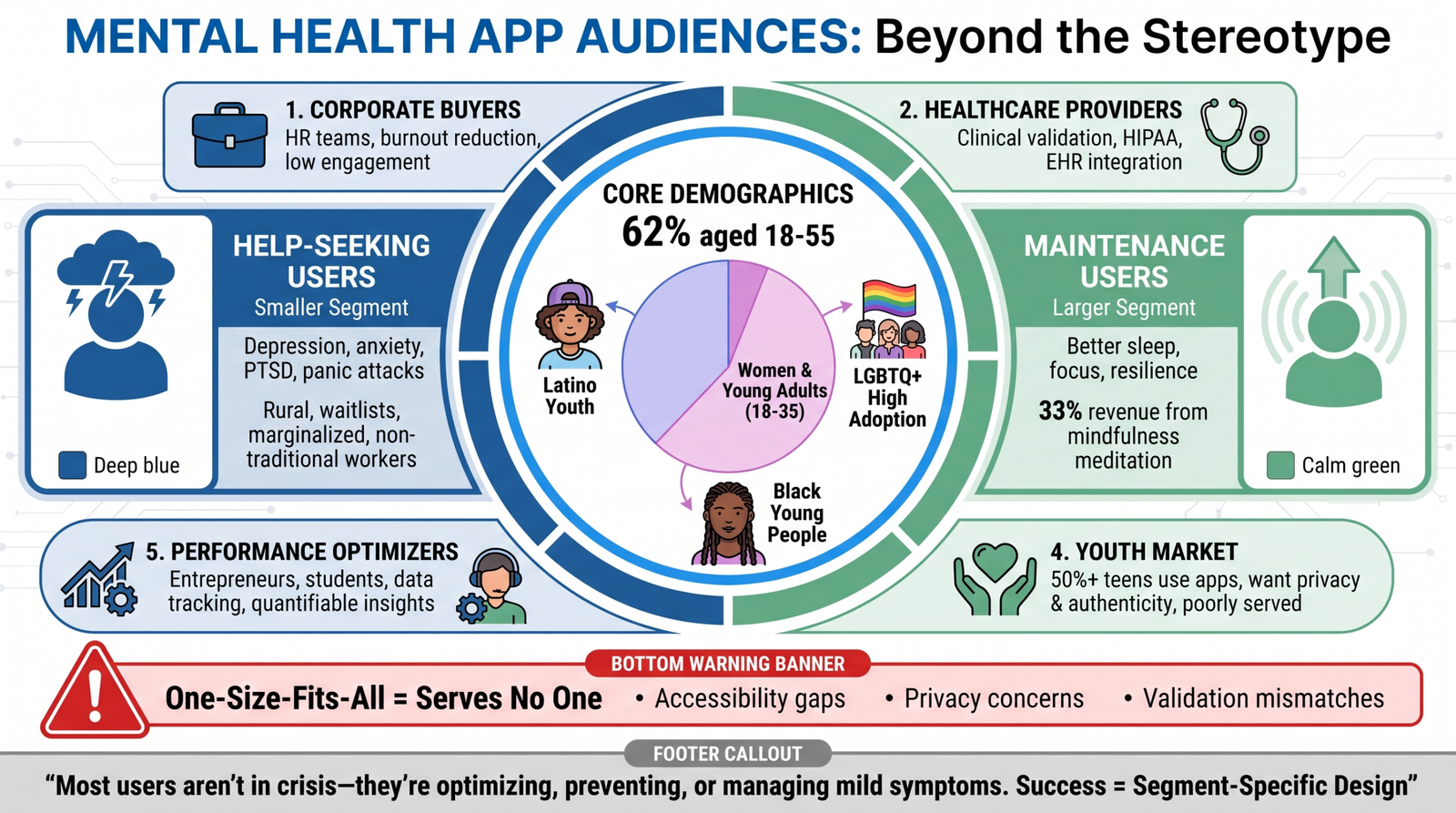
The largest group of mental health app users is adults between 18 and 55, and they make up about 62% of the user base, according to market analyses. (Aziz et al., 2023) Within that group, a huge chunk aren’t necessarily dealing with clinical diagnoses.
They’re what researchers call “maintenance” users, people who are fundamentally okay but want to stay that way, or get even better.
This distinction between help-seeking users and maintenance users matters. Help-seeking users are the ones you’d expect: they’re experiencing distress, symptoms, low mood, panic attacks, intrusive thoughts.
They turn to apps because they need relief, and often they need it fast.
Maintenance users, on the other hand, are looking to improve. They want better sleep, sharper focus, more resilience under pressure, and improved emotional regulation.
They’re not broken; they’re tuning.
And this second group might be even larger than the first, when you look at which apps dominate the market. Mindfulness and meditation apps pull in about a third of all mental health app revenue, and those tools are squarely aimed at wellbeing enhancement, not crisis intervention. (Perez, 2020)
Another fascinating layer is that many apps target “everyone,” which sounds inclusive but creates problems. In one review of 436 mental health apps, 52.5% explicitly targeted adults, 42.2% said “everyone,” and only 31% named teenagers as a primary audience. (Carlo et al., 2019)
Older adults, children, and preteens were barely mentioned.
So when an app says it’s for everyone, it often means, “we designed this for adults but didn’t want to exclude anyone in our marketing.” That vagueness can leave younger users and older adults feeling like they’re trying to fit into a tool that wasn’t really made with them in mind.
Young Adults and Women Drive Most of the Usage
If you zoom in on who’s really driving usage, younger adults and women show up disproportionately. Surveys consistently find that women use mental health and wellbeing apps more than men, and younger adults use them far more than older generations. (Fürtjes et al., 2024)
In some youth-focused studies, over half of teens and young adults report using at least one app to support their mental health or wellbeing in the past year. (Most Teens Seek Mental Health Support Online, 2024)
This is a high adoption rate, particularly given how recently these tools have become widely available.
Young adults prioritize very specific things when they choose an app: accessibility, evidence quality, data security, customizability, and usability. They want tools that are easy to get into, don’t cost a fortune, and actually work based on research, not just flashy marketing.
And they’re acutely aware of privacy.
For this audience, the fear that mood logs or symptom data could end up in the hands of employers, insurers, or even social media platforms is a real barrier. Apps that are vague about data practices or bury their privacy policy in dense legal language lose trust fast.
Interestingly, usage rates among teens and young adults are even higher in certain ethnic and identity groups. Latino youth, Black young people, and LGBTQ+ people show particularly high adoption of behavioral health apps. (Caldwell & Fisher, 2024)
This makes a ton of sense when you think about the systemic barriers these groups face in accessing traditional mental health care: long wait times, cost, stigma, lack of culturally competent providers, or just living in areas where services don’t exist.
Apps become a frontline resource, sometimes the only resource, for young people who need support but can’t or won’t access conventional therapy.
The gender skew is also worth unpacking. Women and girls consistently report higher rates of app usage for mental health, and they’re more likely to track mood, set wellness goals, and stick with apps over time. (Antezana et al., 2022, p. 14604582211064824)
But the irony is that many mental health apps, especially productivity-oriented or performance-focused ones, use branding and imagery that default to male-coded themes: think minimalist interfaces, productivity metrics, and “optimize your brain” language.
If your core users are women and younger adults, and your branding looks like a fintech app for Silicon Valley bros, that mismatch is probably costing you engagement.
Find Your Perfect Mental Health App Match
Answer a few questions to discover which type of mental health app is designed for someone like you
Your Mental Health App Profile
Recommended App Features
Corporate Buyers and Healthcare Providers Represent Massive Hidden Segments
Beyond individual consumers, two huge audience segments operate almost invisibly to the general public: employers and healthcare providers. This is the B2B side of mental health apps, and it’s growing fast.
Employers have become major buyers of mental health apps, rolling them out through employee assistance programs, wellness platforms, and benefits packages. The target here isn’t just stressed-out employees; it’s HR teams and executives looking to reduce burnout, improve retention, boost engagement, and show that they care about staff well-being.
For this audience, apps need group-wide access, anonymized reporting dashboards, content focused on workplace stress and resilience, and clear ROI metrics. Employees might never choose that app on their own, but when it’s offered as a perk or resource, usage becomes part of the company culture.
The challenge with this segment is engagement. Just because an employer buys licenses for 5,000 employees doesn’t mean 5,000 people will actually use the app. In practice, a small fraction logs in regularly, and even fewer stick around past the first month. (Baumel et al., 2019)
So the real target audience here is twofold: the decision-makers who purchase the app, and the subset of employees who are motivated or struggling enough to engage with it.
You’ve got to appeal to both, and that needs different messaging, different features, and different success metrics.
Healthcare providers represent another key audience. Therapists, psychiatrists, primary care doctors, hospitals, and health systems are increasingly using mental health apps for patient monitoring, measurement-based care, remote check-ins, and structured homework between sessions.
These users care intensely about clinical validation, interoperability with electronic health records, HIPAA compliance, and tools that fit into existing workflows.
They’re not looking for cute animations or gamification; they want data they can trust, symptom scales they recognize, and platforms that don’t add administrative burden.
For healthcare providers, the ideal patient audience for these apps is people with mild to moderate symptoms who are either waiting for treatment, supplementing in-person therapy, or maintaining progress after discharge. Apps work really well in stepped care models, where you start with the least intensive effective intervention and scale up only if needed.
A patient with mild anxiety might start with a self-help app, then move to group therapy or one-on-one sessions if symptoms continue. Apps aren’t replacing therapists in this model; they’re extending reach and filling gaps.
Underserved Populations Find Critical Access Through Apps
One of the most compelling aspects of the mental health app audience is how these tools reach people who’ve been systematically underserved by traditional care. Rural populations, for instance, often live hours away from the nearest therapist.
For them, mental health apps can be a primary touchpoint, not a supplement.
The same goes for people in countries or regions with few mental health professionals, or people who work nontraditional hours and can’t make it to a 9-to-5 clinic.
There’s also a large audience of people waiting for treatment. In many healthcare systems, therapy wait times can stretch to weeks or months. (Oneschuk et al., 2024)
During that waiting period, apps can provide structured self-help, symptom tracking, and coping skills.
It’s not a substitute for the eventual therapy session, but it’s better than nothing, and it can prevent deterioration while someone’s on a wait list.
Marginalized communities face extra layers of stigma and mistrust. For LGBTQ+ people, people of color, immigrants, and others who’ve experienced discrimination or microaggressions in healthcare settings, the privacy and autonomy of an app can feel safer than sitting across from a clinician who might not understand their lived experience.
Apps marketed with inclusive language, diverse representation, and culturally adapted content can really resonate with these audiences, but only if they follow through on privacy and avoid exploitative data practices.
On the flip side, these same populations are often the most vulnerable to poor-quality apps. If you’re using an app because it’s your only option, you’re less likely to vet it carefully or demand evidence.
That creates a responsibility for developers, marketers, and affiliates to steer these users toward tools that are safe, secure, and actually helpful, not just the ones with the biggest ad budgets.
Youth Represent a Huge Market, But Design Often Misses the Mark
Teens and young people represent a massive and growing audience for mental health apps, but there’s a weird disconnect in how apps target them. Most apps don’t explicitly name young people as their primary audience, even when their app store age rating and interface suggest they’re meant for all ages.
In one European audit of youth mental health apps, researchers found that very few apps had been designed with young people’s developmental needs, preferences, or safety concerns in mind. Instead, most were adult tools with a lower age rating slapped on. (Cagigal et al., 2026)
This matters because teens and young adults use smartphones differently than older adults, process information differently, and have different triggers for engagement and dropout. An app that works great for a 35-year-old professional might feel patronizing or boring to a 16-year-old.
Conversely, gamification or social features that appeal to teens might feel trivial to adults dealing with serious symptoms.
Youth usage data shows that over half of teens have tried a mental health or wellbeing app, and usage is especially high among young women and Latino youth. (Faverio & Sidoti, 2024) These young users want tools that feel private, don’t require parental permission, don’t cost money, and offer real strategies they can use in school or social situations.
They’re also highly attuned to authenticity; if an app feels like it was made by out-of-touch adults, they’ll delete it instantly.
The challenge for developers and marketers is deciding whether to build youth-specific tools or design for broad age ranges with customizable content. Youth-specific apps can be more targeted and effective, but they also face hurdles around parental consent, school partnerships, and age verification.
All-ages apps can reach more people, but risk diluting their message and missing the mark for everyone.
Performance Optimization: Users Want an Edge, Not Treatment
Here’s where things get really interesting and a bit counterintuitive. A significant chunk of mental health app users aren’t dealing with mental health problems at all; they’re using these tools to get an edge.
They want to sleep better so they can wake up sharper.
They want to manage stress so they can perform under pressure. They want to boost focus, creativity, decision-making, and resilience.
This is the performance and optimization audience, and they’re a major driver of growth in the mindfulness and wellbeing app market.
Think about entrepreneurs tracking their mood alongside their business metrics, trying to understand which emotional states correlate with good decisions. Or college students using CBT apps not because they have clinical anxiety, but because they want to manage pre-exam jitters and improve their GPA.
Or remote workers using meditation apps to create boundaries between work and home when both happen in the same room.
These users are treating mental health tools the same way athletes treat nutrition and training, as part of a broader system for optimizing performance and achieving goals.
This audience cares a lot about data. They want to track trends over time, see correlations between habits and mood, and quantify progress.
They’re already using fitness trackers, sleep watches, and productivity apps, and they want their mental health app to fit into that ecosystem.
For them, a simple journaling app or a generic meditation library isn’t enough; they want dashboards, insights, and actionable recommendations based on their patterns.
The downside is that this audience can also drive app design in directions that don’t serve people with clinical needs. If the loudest users are performance-focused optimizers, developers might prioritize features like streaks, badges, leaderboards, and aggressive goal-setting, which can backfire for someone dealing with depression or burnout. The gamification that motivates one segment can feel trivializing or exhausting to another.
Caregivers and Indirect Users Have Different Needs
Not everyone using a mental health app is using it for themselves. A whole audience of caregivers, parents, partners, siblings, and friends downloads apps to understand better and support someone they care about.
A parent might use a teen anxiety app first to see if it’s safe and helpful before suggesting it to their kid. A partner might use a couples therapy app to work on communication patterns.
A sibling might track their own mood to understand how it’s affected by caring for a family member with severe mental illness.
These indirect users have different needs. They’re not necessarily looking for symptom relief for themselves; they’re looking for education, strategies, and tools to better support someone. Apps that include caregiver modes, family resources, or educational content for loved ones can serve this audience well, but most apps don’t even consider it.
There’s also a growing segment of people using mental health apps in parallel with traditional therapy. They’re not replacing their therapist; they’re using the app for homework, between-session practice, or tracking that they can bring into their next appointment.
For this audience, the app is part of a hybrid care model, and they need tools that combine well with clinical workflows and don’t create conflicting advice or duplication.
Common Targeting Problems Create Serious Mismatches
With such a diverse audience, targeting can go wrong in many ways. One of the biggest pitfalls is the “for everyone” trap.
When an app tries to serve everyone, it often ends up serving no one particularly well.
A meditation app built for stressed professionals might bore a teen. A CBT tool designed for clinical depression might overwhelm someone with mild situational anxiety.
A mindfulness app marketed to “everyone” might fail to address the specific concerns of people dealing with trauma, chronic pain, or severe mental illness.
Another common problem is assuming that “accessibility” means low cost or easy downloads. Real accessibility means considering users with disabilities, non-English speakers, people with limited digital literacy, and those with intermittent internet access.
Most mental health apps fall short on these dimensions, which excludes large chunks of their potential audience even when they claim to be inclusive. (Litke et al., 2023)
Privacy mismatches are also a huge issue. Young adults and marginalized groups care deeply about data security, but many apps have vague privacy policies, share data with third parties, or don’t encrypt sensitive information.
If your target audience includes people who are worried about employers, insurers, or governments accessing their mental health data, and your app doesn’t have rock-solid privacy protections, you’re going to lose that audience fast, and you should.
There’s also the mismatch between marketing and actual use cases. Many apps market themselves as evidence-based or clinically validated. Still, when you dig into the research, you find that studies were done on small samples, for short durations, or in controlled settings that don’t reflect real-world use. (Linardon et al., 2024, pp. 139-149)
If your target audience is people seeking legitimate therapeutic help, and your app doesn’t actually deliver on its clinical promises, that’s not just bad marketing; it’s potentially harmful.
Tailoring Features and Messaging to Specific Segments
If you’re building, marketing, or recommending mental health apps, match features and messaging to specific audience segments. For young adults and youth, prioritize privacy, customizability, and transparency about evidence.
Show them exactly what data you collect, why you collect it, and how you protect it. Let them tailor the app’s tone, visuals, and content to fit their preferences.
Don’t talk down to them, and don’t assume they’re not savvy about research quality.
For performance-focused users, emphasize data tracking, insights, and integration with other tools. Offer advanced analytics, trend visualization, and correlations between mood, sleep, exercise, and productivity.
Give them control over their data and let them export it for use in other apps or personal tracking systems.
For help-seeking users with clinical symptoms, prioritize evidence-based interventions, clear guidance on when to seek professional help, and safety features like crisis resources and risk assessments. Don’t over-gamify, and don’t promise quick fixes.
Be honest about what the app can and can’t do, and make it easy for users to transition to higher levels of care if needed.
For employers and HR teams, emphasize scalability, reporting, and ROI. Provide anonymized usage and engagement data, content tailored to workplace stress and resilience, and integration options with existing wellness platforms.
Also design the app so employees feel genuinely supported, not surveilled.
For healthcare providers, focus on clinical validation, interoperability, and workflow integration. Offer structured assessments, symptom tracking that maps onto standard diagnostic tools, and secure data sharing with electronic health records.
Make it easy for providers to assign specific modules, review patient progress, and talk within the app.
People Also Asked
Who uses mental health apps the most?
Women and young adults between 18 and 35 use mental health apps more frequently than other demographics. Within youth populations, Latino youth, Black young people, and LGBTQ+ people show particularly high adoption rates, often using apps as a primary mental health resource when traditional care is inaccessible or feels unsafe.
Are mental health apps effective for anxiety?
Mental health apps can be effective for mild to moderate anxiety, especially those based on cognitive behavioral therapy (CBT) principles. Research shows that structured CBT apps can reduce anxiety symptoms when used consistently. However, they work best as part of a broader treatment plan or for people waiting to access professional therapy.
Can employers see my mental health app data?
This depends entirely on the app and how it was deployed. If your employer purchased group licenses, many apps provide only anonymized, aggregate data to the company, but you should always read the privacy policy carefully. Apps that don’t explicitly guarantee personal data privacy may share information with your employer or other third parties.
What age group needs mental health apps most?
While young adults show the highest usage rates, the question of “need” is more complex. Teens and young adults often face barriers to accessing traditional care, making apps a critical resource.
However, older adults, rural populations, and people from marginalized communities also have significant unmet mental health needs that apps could address if better designed for these groups.
Do mental health apps really help with depression?
Evidence-based mental health apps can help with mild to moderate depression, particularly those offering structured cognitive behavioral therapy or behavioral activation. However, apps are generally not enough as the sole treatment for severe or clinical depression and should be used alongside professional care.
Always ask a healthcare provider if you’re experiencing significant depressive symptoms.
Are free mental health apps safe to use?
Not all free mental health apps are safe or effective. Many collect and share user data without clear disclosure, lack evidence-based content, or make exaggerated claims.
Before using a free app, check its privacy policy, look for clinical validation or professional endorsements, and verify that it doesn’t share sensitive data with advertisers or third parties.
What’s the difference between wellness apps and mental health apps?
Wellness apps typically focus on optimization and prevention, better sleep, stress management, and mindfulness, for people who are generally functioning well. Mental health apps may target specific clinical conditions like depression or anxiety and often include structured therapeutic interventions.
However, the line between categories is blurry, and many apps serve both audiences.
Key Takeaways
The target audience for mental health apps spans a surprisingly wide range: adults and younger adults with stress and wellbeing goals, teens seeking private support, maintenance users optimizing performance, help-seeking users managing clinical symptoms, employers deploying apps at scale, healthcare providers integrating tools into care, and underserved populations using apps to bridge gaps in access. Most users aren’t in crisis; they’re managing mild symptoms, preventing future problems, or chasing peak performance.
Women and young adults drive adoption, especially in marginalized communities where traditional care is hard to access.
Youth are heavy users but often overlooked in design, while corporate and healthcare segments represent huge but invisible audiences with very different needs. Privacy, evidence, usability, and customizability matter intensely to most segments, and apps that try to serve everyone often end up serving no one well.
References
Aziz, M., Erbad, A., Belhaouari, S. B., Almourad, M. B., Altuwairiqi, M. & Ali, R. (2023). Who Uses Mhealth? User Archetypes for Physical and Mental Health Apps. SAGE Open Medicine 11. https://doi.org/10.1177/20552076231152175
Perez, S. (January 29, 2020). Top 10 meditation apps pulled in $195M in 2019, up 52% from 2018. TechCrunch. https://techcrunch.com/2020/01/30/top-10-meditation-apps-pulled-in-195m-in-2019-up-52-from-2018/
Carlo, A. D., Ghomi, R. H., Renn, B. N. & Areán, P. A. (2019). By the numbers: ratings and utilization of behavioral health mobile applications. npj Digital Medicine 2. https://doi.org/10.1038/s41746-019-0129-6
Fürtjes, S., Gebel, E., Kische, H. & Beesdo-Baum, K. (2024). Characteristic of mental health app usage: a cross-sectional survey in the general population. BMC Public Health 24. https://doi.org/10.1186/s12889-024-20500-1
(July 21, 2024). Most Teens Seek Mental Health Support Online. GovTech. https://www.govtech.com/education/k-12/most-teens-seek-mental-health-support-online
Caldwell, J. & Fisher, J. (2024). Getting Help Online: How Young People Find, Evaluate, and Use Mental Health Apps, Online Therapy, and Behavioral Health Information. Common Sense Media. https://www.commonsensemedia.org/research/getting-help-online-how-young-people-find-evaluate-and-use-mental-health-apps-online-therapy-and-behavioral
Antezana, G., Venning, A., Smith, D. & Bidargaddi, N. (2022). Do young men and women differ in well-being apps usage? Findings from a randomised trial. Health Informatics Journal 28(1), p. 14604582211064824. https://doi.org/10.1177/14604582211064825
Baumel, A., Muench, F., Edan, S. & Kane, J. M. (2019). Objective User Engagement With Mental Health Apps: Systematic Search and Panel-Based Usage Analysis. Journal of Medical Internet Research 21(9). https://doi.org/10.2196/14567
Oneschuk, H., Tuckerman, A., Archer, C. & Vasudev, K. (2024). Reducing wait times for hospital-based outpatient mental healthcare: what works?. BMJ Open Quality 15(1). https://doi.org/10.1136/bmjoq-2024-003031
Cagigal, A. M., Akyol, C. C., Angın, N. C., Ferreira, J., Gabor-Siatkowska, K., Männikkö, N., Meyniel, A., Özdemir, N. Ö., Stojadinović, M., Varga, V., Beyens, I. & Pretorius, C. (2026). Digital mental health apps for young people in Europe: A systematic cross-country analysis. PLOS Digit Health 5(8). https://doi.org/10.1371/journal.pdig.0001622
Faverio, M. & Sidoti, O. (December 11, 2024). Teens, Social Media and Technology 2024. Pew Research Center. https://www.pewresearch.org/internet/2024/12/12/teens-social-media-and-technology-2024/
Litke, S. G., Resnikoff, A., Anil, A., Montgomery, M., Matta, R., Huh-Yoo, J. & Daly, B. P. (2023). Mobile Technologies for Supporting Mental Health in Youths: Scoping Review of Effectiveness, Limitations, and Inclusivity. JMIR Mental Health 10. https://doi.org/10.2196/46949
Linardon, J., Torous, J., Firth, J., Cuijpers, P., Messer, M. & Fuller-Tyszkiewicz, M. (2024). Current evidence on the efficacy of mental health smartphone apps for symptoms of depression and anxiety. A meta-analysis of 176 randomized controlled trials. World Psychiatry 23(1), pp. 139-149. https://doi.org/10.1002/wps.21183